A scoreboard can be well-built, brightly lit, and perfectly sized for your venue, but if it is positioned poorly, none of those qualities matter as much as they should. Thoughtful scoreboard placement is what turns a good display into one that actually serves everyone in the building or on the field. Getting it right takes some planning upfront, but the payoff lasts for the entire life of the installation.
Why Placement Decisions Deserve More Attention
Most facilities focus heavily on which scoreboard to buy and far less on exactly where to put it. That order of priority often leads to installations that work adequately but never quite feel right. Fans strain to see from certain sections. Glare becomes a recurring complaint. Officials have to shift their position to get a clear read on the clock.
Placement decisions made carefully at the planning stage prevent all of those problems. They also ensure that the investment you make in a quality display actually delivers the visibility and impact it was designed for.
Start With Your Viewing Zones
Before settling on a placement location, map out where your audience actually sits. Different venues have very different seating configurations, and the scoreboard needs to serve the largest possible portion of that audience simultaneously.
In most facilities, there is a primary viewing zone where the majority of fans are seated and one or more secondary zones along the baselines, end zones, or side areas. Ideally, your scoreboard placement addresses the primary zone directly while remaining at least partially visible to secondary areas. If your venue has seating on multiple sides, this analysis becomes even more important and may point toward multiple displays or a centrally positioned unit.
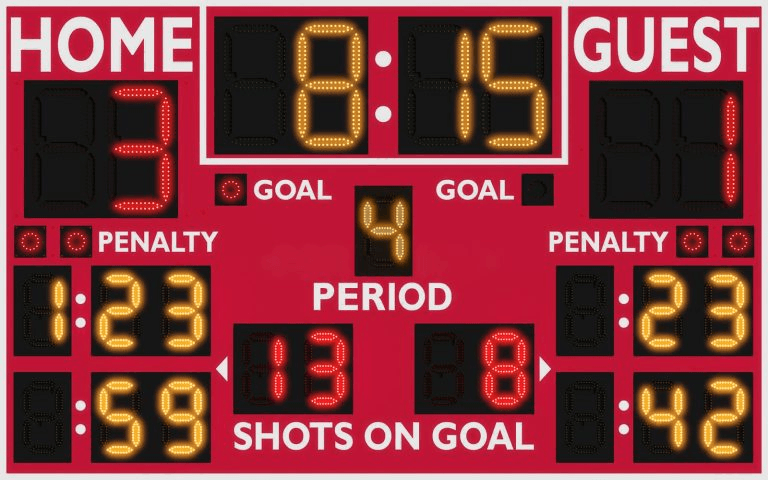
Scoreboard Placement for Indoor Facilities
Indoor gyms present a specific set of placement challenges. Ceiling height, wall dimensions, support structures, and lighting fixtures all factor into where a display can realistically be mounted. End wall placements are the most common for indoor facilities because they position the scoreboard in the direct line of sight for fans seated along the sidelines, which is where most of the seating typically is.
Side wall placements work in some configurations but require careful attention to viewing angles. A display mounted too far to one side may be easy to read from half the gym while being awkward or obstructed from the other half.
Facilities hosting basketball should review basketball scoreboard placement guidelines specific to court dimensions and seating layouts before finalizing a location. The same applies to volleyball programs, where volleyball scoreboard placement needs to account for the net position and the typical orientation of player and fan sightlines.
Scoreboard Placement for Outdoor Fields
Outdoor venues introduce additional variables, including sun position, wind exposure, and the much greater distances between the display and the farthest viewers. Press boxes, bleacher structures, and existing infrastructure all influence what placement options are practical.
For football facilities, the scoreboard is typically positioned at one end of the field where it can be seen from both sideline bleacher sections simultaneously. Reviewing how football scoreboards are typically configured for field-level visibility helps narrow down the right location for your specific layout.
Baseball venues have a more enclosed viewing geometry, and baseball scoreboard placement often takes advantage of outfield fence or berm positions that keep the display in the natural eyeline of fans seated behind home plate and along the baselines.
Sun Angle and Glare Are Real Placement Factors
One of the most commonly overlooked placement considerations is sun position during your primary game times. A scoreboard facing directly into the afternoon sun may produce glare that makes it difficult to read during peak afternoon events. One positioned with the sun behind it may create problems for fans looking directly into the light to read the display.
Walk your venue at the times of day when most games are scheduled and observe where the sun falls. That simple exercise can reveal glare issues that would be expensive to address after installation. For outdoor facilities, choosing a placement that puts the display at an angle to the sun's typical path during game hours makes a significant difference in readability across an entire season.
Mounting Height Affects Both Visibility and Safety
Getting the mounting height right is a balance between visibility and safety. A display mounted too low may have sightline obstructions from standing crowds or floor-level equipment. One mounted too high can create neck strain for fans in close sections and may reduce readability at steep downward angles.

For indoor facilities, mounting height is often constrained by ceiling clearance and structural support locations. For outdoor installations, there is typically more flexibility, but local permitting requirements and wind load ratings for the support structure need to be factored into the decision. Working with an experienced installation team helps navigate those technical requirements without compromising the visibility goals.
Multiple Displays as a Placement Strategy
Some venues are simply too large or too irregular in shape for a single display to serve the entire audience effectively. In those cases, a multi-display strategy may be the right answer. Smaller supplementary displays positioned at secondary viewing zones can fill in the gaps that a single primary unit cannot cover.
This approach is increasingly common in facilities that host multiple sports with different seating configurations. Planning for multiple displays from the beginning, even if the secondary units are added later, allows the primary placement to be chosen with the full system in mind rather than as a standalone decision. Knowing which type of scoreboard is best for your facility is the natural starting point before any placement decisions are made.
Get Your Scoreboard Placement Right From the Start
Placement is one of those decisions that is much easier to get right the first time than to correct after the fact. Taking the time to assess your venue, map your viewing zones, and account for lighting and structural factors sets your installation up for long-term success.
At Varsity Scoreboards, we offer a variety of scoreboards and video displays suited to facilities of every size and configuration, and our team can help you think through placement as part of the selection process.
And if budget is a factor, we can help you secure sponsorship for a new scoreboard or video display so the right solution stays within reach. Get in touch today.